Robbie Hatley's Solutions, in Perl, for The Weekly Challenge #351 (“Special Average” and “Arithmetic Progression”)
For those not familiar with "The Weekly Challenge", it is a weekly programming puzzle with two parts, with a new pair of tasks each Monday. You can find it here: The Weekly Challenge
The Weekly Challenge for the week of 2025-12-08 through 2025-12-14 is #351. The tasks for challenge #351 are as follows:
~~~~~~~~~~~~~~~~~~~~~~~~~~~~~~~~~~~~~~~~~~~~~~~~~~~~~~~~~~~~~~~~~
Task 351-1: Special Average
Submitted by: Mohammad Sajid Anwar
You are given an array of integers. Write a script to return the
average excluding the minimum and maximum of the given array.

Example #1:
Input: @ints = (8000, 5000, 6000, 2000, 3000, 7000)
Output: 5250
Min: 2000
Max: 8000
Avg: (3000+5000+6000+7000)/4 = 21000/4 = 5250

Example #2:
Input: @ints = (100_000, 80_000, 110_000, 90_000)
Output: 95_000
Min: 80_000
Max: 110_000
Avg: (100_000 + 90_000)/2 = 190_000/2 = 95_000

Example #3:
Input: @ints = (2500, 2500, 2500, 2500)
Output: 0
Min: 2500
Max: 2500
Avg: 0

Example #4:
Input: @ints = (2000)
Output: 0
Min: 2000
Max: 2000
Avg: 0

Example #5:
Input: @ints = (1000, 2000, 3000, 4000, 5000, 6000)
Output: 3500
Min: 1000
Max: 6000
Avg: (2000 + 3000 + 4000 + 5000)/4 = 14000/4 = 3500
I'll numerically sort the array, shift all min elements, pop all max elements, and average the remainder. I'll also generalize my script so that it can handle any real numbers.
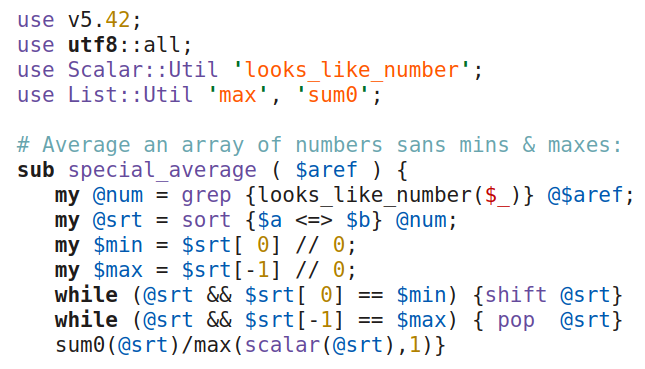
Robbie Hatley's Perl Solution to The Weekly Challenge 351-1
~~~~~~~~~~~~~~~~~~~~~~~~~~~~~~~~~~~~~~~~~~~~~~~~~~~~~~~~~~~~~~~~~
Task 351-2: Arithmetic Progression
Submitted by: Mohammad Sajid Anwar
You are given an array of numbers. Write a script to return true
if the given array can be re-arranged to form an arithmetic
progression, otherwise return false. A sequence of numbers is
called an arithmetic progression if the difference between any
two consecutive elements is the same.

Example 1
Input: @num = (1, 3, 5, 7, 9)
Output: true
Already AP with common difference 2.

Example 2
Input: @num = (9, 1, 7, 5, 3)
Output: true
The given array re-arranged like (1, 3, 5, 7, 9)
with common difference 2.

Example 3
Input: @num = (1, 2, 4, 8, 16)
Output: false
This is geometric progression and not arithmetic progression.

Example 4
Input: @num = (5, -1, 3, 1, -3)
Output: true
The given array re-arranged like (-3, -1, 1, 3, 5)
with common difference 2.

Example 5
Input: @num = (1.5, 3, 0, 4.5, 6)
Output: true
The given array re-arranged like (0, 1.5, 3, 4.5, 6)
with common difference 1.5.
Let @srt = sort {$a<=>$b} @num. Then if $num[$idx-0]-$num[$idx-1] != $num[$idx-1]-$num[$idx-2] for any $idx > 1, return false; otherwise, return true.
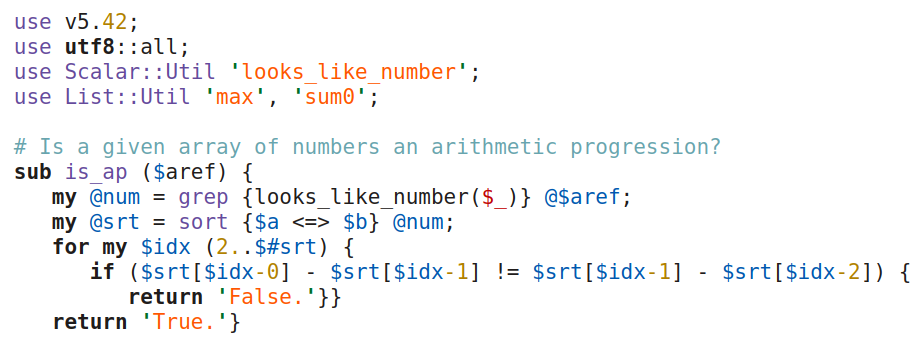
Robbie Hatley's Perl Solution to The Weekly Challenge 351-2
That's it for challenge 351; see you on challenge 352!


Comments
Post a Comment