Robbie Hatley’s Solutions, in Perl, for The Weekly Challenge #368 (“Make it Bigger” and “Big and Little Omega”)
For those not familiar with "The Weekly Challenge", it is a weekly programming puzzle with two parts, with a new pair of tasks each Monday. You can find it here: The Weekly Challenge
The Weekly Challenge for the week of 2026-04-06 through 2026-04-12 is #368. The tasks for challenge #368 are as follows:
~~~~~~~~~~~~~~~~~~~~~~~~~~~~~~~~~~~~~~~~~~~~~~~~~~~~~~~~~~~~~~~~~
Task 368-1: Make it Bigger
Submitted by: Mohammad Sajid Anwar
You are given a given a string number and a character digit.
Write a script to remove exactly one occurrence of the given
character digit from the given string number, resulting in
the number being maximised.

Example #1:
Input: $str = "15456", $char = "5"
Output: "1546"
Removing the second "5" is better because the digit following
it (6) is greater than 5. In the first case, 5 was followed by 4
(a decrease), which makes the resulting number smaller.

Example #2:
Input: $str = "7332", $char = "3"
Output: "732"

Example #3:
Input: $str = "2231", $char = "2"
Output: "231"
Removing either "2" results in the same string here. By removing
a "2", we allow the "3" to move up into a higher decimal place.

Example #4:
Input: $str = "543251", $char = "5"
Output: "54321"
If we remove the first "5", the number starts with 4. If we
remove the second "5", the number still starts with 5. Keeping
the largest possible digit in the highest place value is almost
always the priority.

Example #5:
Input: $str = "1921", $char = "1"
Output: "921"
To solve this problem, I'll use the "try it and see" method: try each possible removal and see which yields the greatest number.
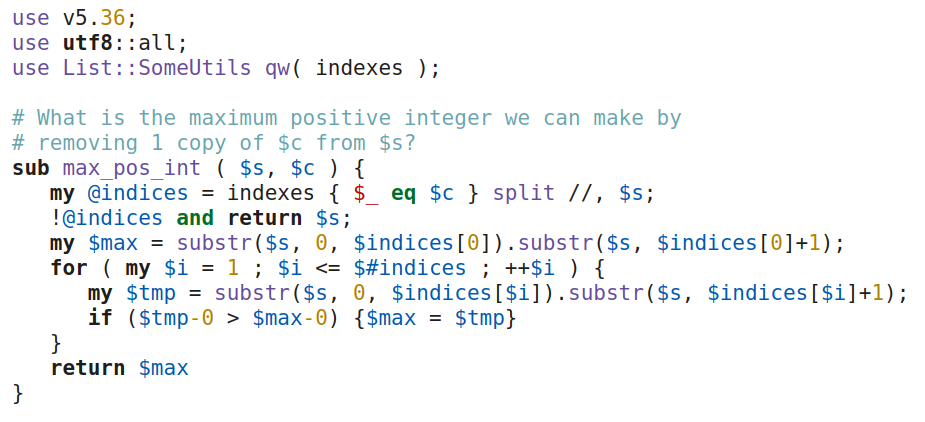
Robbie Hatley's Perl Solution to The Weekly Challenge 368-1
~~~~~~~~~~~~~~~~~~~~~~~~~~~~~~~~~~~~~~~~~~~~~~~~~~~~~~~~~~~~~~~~~
Task 367-8: Big and Little Omega
Submitted by: Roger Bell_West
You are given a positive integer $number and a mode flag $mode.
If the mode flag is zero, calculate little omega (the count of
all distinct prime factors of that number). If it is one,
calculate big omega (the count of all prime factors including
duplicates).

Example #1:
Input: $number = 100061
$mode = 0
Output: 3
Prime factors are 13, 43, 179. Count is 3.

Example #2:
Input: $number = 971088
$mode = 0
Output: 3
Prime factors are 2, 2, 2, 2, 3, 20231.
Count of distinct numbers is 3.

Example #3:
Input: $number = 63640
$mode = 1
Output: 6
Prime factors are 2, 2, 2, 5, 37, 43.
Count including duplicates is 6.

Example #4:
Input: $number = 988841
$mode = 1
Output: 2

Example #5:
Input: $number = 211529
$mode = 0
Output: 2
To solve this problem, I'll need a short, fast "factor" algorithm. Then just use "scalar" to count all factors, and "scalar uniq" to count unique factors.
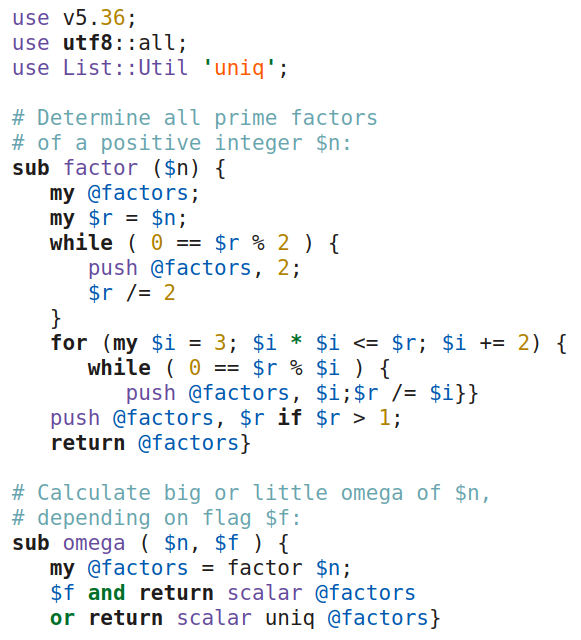
Robbie Hatley's Perl Solution to The Weekly Challenge 368-2
That's it for challenge 368; see you on challenge 369!


Comments
Post a Comment